Back
Back

Scenario modelling has formed part of Peregrine Wealth’s investment philosophy for over two decades, and it enables us to better understand potential market outcomes and construct stronger portfolios. The Peregrine Wealth Investment Management team has a core or “High Conviction” scenario based on a three-year view, which is expressed as macroeconomic and market assumptions, including economic growth, inflation, interest rates, price-earnings multiples, and credit spreads, to list a few. Based on these assumptions, our asset valuation models produce expected returns for various asset classes. This section is used to summarise our High Conviction view and the resulting asset signals.
High conviction scenario: medium-term expected returns
Under our High Conviction scenario, we have reduced our one-year economic growth expectations across all major regions following the outbreak of the war in Iran, the resulting spike in energy prices, and likely shortage of energy and related byproducts. We assume, however, that the global economy will rebound and grow around capacity in year’s two and three of our projection period. As a result, our three-year economic growth assumption is now slightly below capacity. Inflation assumptions were increased for the near term due to higher energy and transport costs, but inflation is expected to moderate again over the three-year projection horizon.
In terms of monetary policy, we now assume central banks will move more cautiously in the near term and previously assumed interest rate cuts for the United States (US) and the United Kingdom (UK) have now been pushed later into 2026 and 2027. The European Central Bank is expected to remain on hold, while a further rate hike is expected in Japan. Government bonds have sold off since the start of March and their yields are now close to our fair value assumptions in most regions. Credit spreads (the difference between higher-risk corporate bonds and lower-risk government bonds) have started widening but remain tighter than our fair‑value assumptions, reflecting generally healthy corporate fundamentals.
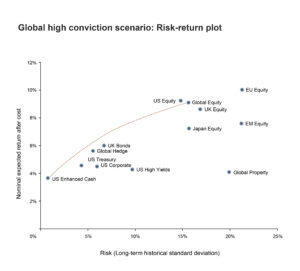
Equity earnings growth is expected to remain fairly attractive over the next three years, despite the current deterioration in global conditions. Valuations have improved as markets have sold off, especially in the US where near-term earnings growth is expected to be strong. Global equities and the major regions are currently rated neutral over the medium term, with the strongest signal coming from US equities.
The UK’s outlook has softened in the near term, reflecting weaker growth momentum and renewed inflationary pressures. Under our High Conviction scenario, we assume that conditions stabilise over the medium term, with inflation easing back towards target. The Bank of England is expected to proceed cautiously with policy easing, with previously anticipated rate cuts now deferred further into the outlook period. UK government bond yields remain elevated and volatile, and we maintain a neutral stance on gilts. Credit markets continue to be supported by generally resilient corporate balance sheets, with spreads reflecting current conditions reasonably well. UK equities continue to screen attractively on valuation metrics, although earnings momentum remains subdued. Overall, medium‑term expected returns for UK assets remain neutral.
The chart below shows the three-year expected return versus the historical standard deviation of each asset class, based on our High Conviction scenario.
Near-term asset class views
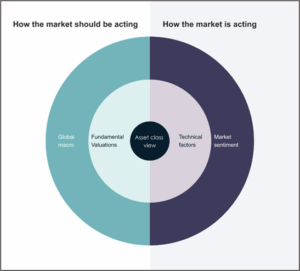
Our investment process is anchored by a High Conviction macroeconomic scenario and the corresponding expected returns for asset classes. This foundation helps us form expectations about how markets should behave. However, we are keenly aware that short-term market behaviour frequently deviates from these expectations. We have long recognised that medium-term, valuation-based signals are often poor guidance for short-term asset performance.
To address this, we’ve developed a range of tools and indicators to enhance our short-term analysis. These include a close examination of market dynamics, cross-asset correlations, and currency and commodity trends, and several other technical factors. These insights help us adapt our views and make more informed short-term decisions.
The diagram below gives a visual representation of how these two parts of the process play into each other.
In addition to our top-down (looking at the broader market) analysis, we integrate the bottom-up (company) insights provided by our analysts. Their detailed research on individual companies and sectors plays a crucial role in shaping our overall views. When bottom-up analysis reveals fundamentals that diverge from market signals – positive or negative – we take this into account in refining our positioning. This dynamic approach allows us to balance macroeconomic factors with granular insights, ensuring our investment decisions reflect both the broader market environment and underlying characteristics of individual assets.
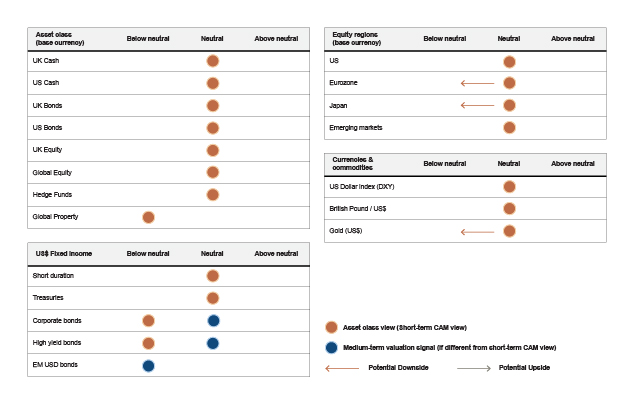
Our latest asset class views are summarised below. The orange circles represent the short-term views from the team, sometimes with an additional arrow if a Neutral view has more up or downside potential. Where the High Conviction scenario medium-term signals are different from the short-term views, it is indicated in blue. To determine the signal as Neutral or Above and Below, the model compares expected returns to what investors have historically required from these asset classes. For example, a Neutral Outlook implies a real expected return range of -0.5% to 1.5% for US Cash, 0.5% to 3.5% for US Bonds, and 3.5% to 8.5% for Global Equity. Views are expressed in the base currency of each asset class; currencies views are expressed separately.